
buyer guide
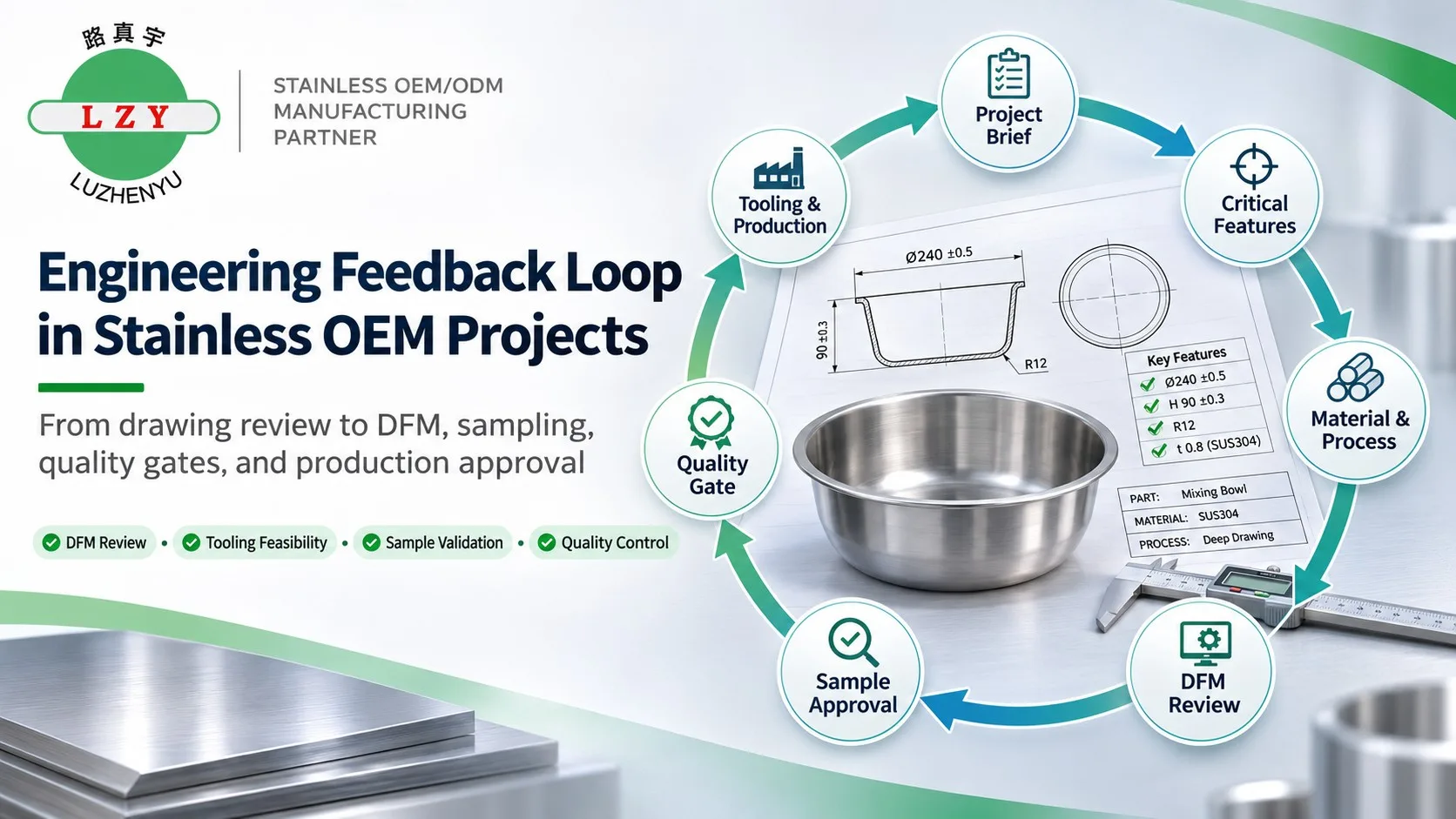
The Engineering Feedback Loop in a Stainless OEM Project
Send your drawing for DFM review
Even a rough print, target volume, and finish requirement are enough for a go/no-go and next-step reply within one business day.
A strong engineering feedback loop turns a drawing into a manufacturable, inspectable, and repeatable production plan. It should be visible before a buyer commits to tooling.
What should the loop contain?
The buyer sends geometry and requirements; engineering identifies risks and questions; both parties agree the route and critical features; samples validate the assumptions; production records the approved result.
What makes it efficient?
Use revision control, a single question list, marked-up drawings, clear decision owners, and a documented response to every critical issue.
Review the related capability or request an engineering review.
Start with a complete project brief
For the engineering feedback loop in a stainless oem project, this intake list keeps the first supplier conversation specific enough to produce a useful feasibility response. Before quotation, prepare the strongest information available: the part purpose, mating components, overall envelope, material target, thickness range, surface or cosmetic requirement, expected launch quantity, annual volume tiers, destination market, packaging channel, and required timing. A drawing is valuable, but a sample, marked photograph, draft CAD file, or measurement table can also start the review. Label assumptions clearly so an engineering question is not mistaken for an approved requirement.
Separate critical features from reference dimensions
In the engineering feedback loop in a stainless oem project, apply this DFM check to the actual geometry, material, and trial result rather than to a generic capability claim. Mark the features that control safety, fit, movement, sealing, food contact, appearance, or downstream assembly. A supplier can then focus the DFM review on the dimensions that change the process route. Reference dimensions, marketing capacity, and non-functional surfaces should be identified separately. This avoids spending tooling time on a cosmetic number while a hidden hub, rim, base, handle, or weld interface remains undefined.
Review material and process assumptions together
Material grade, thickness, temper, coil or sheet condition, forming depth, corner radius, lubrication, trimming, welding, cleaning, and finishing interact. Changing one assumption can change the others. Ask the supplier to state the assumed route and the risks that still require sampling. When the project concerns engineering, DFM, OEM development, the quotation should also state which operation owns each acceptance criterion and where the buyer must approve a change.
Use DFM to prevent late change orders
In the engineering feedback loop in a stainless oem project, apply this DFM check to the actual geometry, material, and trial result rather than to a generic capability claim. A practical DFM review identifies drawability, thinning, wrinkling, springback, tool access, weld distortion, polishing access, trim allowance, inspection datums, and packaging risks before steel is cut. It should return marked-up drawings or a question list, not only a unit price. If the geometry is outside a proven route, the supplier should explain whether a multi-pass route, restrike, secondary operation, prototype, or new fixture is needed.
Define the sample and approval gate
For the engineering feedback loop in a stainless oem project, separate what the first sample proves from what still needs production-tool validation. Agree what the first sample can prove and what it cannot prove. A prototype may confirm envelope and user interaction while a production tool sample is needed to validate material flow, wall variation, rim behavior, weld strength, finish, and repeatability. Define the revision, material, inspection method, limit samples, sample quantity, response time, and sign-off owner. A signed sample is a control reference for the pilot and the first recurring purchase order.
Connect quality gates to the part risk
For the engineering feedback loop in a stainless oem project, define the acceptance method and record owner before the part reaches the next gate. Incoming material checks, first article inspection, in-process patrols, final inspection, and shipment records should each have a purpose. For a critical interface, define the gauge or datum. For a cosmetic surface, define the visible zone, lighting, viewing distance, limit sample, and defect grading. For a food-contact or target-market requirement, define the document or test scope. A generic promise such as premium quality or full inspection is not a measurable acceptance standard.
Clarify tooling, ownership, and maintenance
For the engineering feedback loop in a stainless oem project, separate what the first sample proves from what still needs production-tool validation. Tooling scope should identify the draw die, trim die, weld fixture, gauges, polishing fixtures, and any secondary tools. The agreement should state who owns customer-funded tooling, where it is stored, who can use it, how maintenance is recorded, and what happens if the forecast pauses or the supplier changes. These records support continuity and reduce disputes when a program moves from prototype to repeat production.
Plan the commercial and schedule gates
For the engineering feedback loop in a stainless oem project, define the acceptance method and record owner before the part reaches the next gate. Lead time should be separated into engineering review, drawing approval, tooling, trial, sample shipment, buyer approval, pilot, production release, and export preparation. Cost should be compared on the same assumptions for material, finish, volume, packaging, tooling, inspection, documentation, Incoterms, and payment. When a quote looks shorter or cheaper, ask which gate or responsibility has been excluded rather than comparing one unit price in isolation.
Prepare a production-ready RFQ
For the engineering feedback loop in a stainless oem project, this intake list keeps the first supplier conversation specific enough to produce a useful feasibility response. Send the drawing or best available concept, a list of critical features, material and finish target, target market, volume tiers, sample expectations, packaging instructions, and a contact who can approve engineering questions. Link the request to the relevant capability page at the capability review and the relevant program context at the appliance parts reference page. The goal is a scoped engineering response that explains the next decision.
Common failure modes to prevent
For the engineering feedback loop in a stainless oem project, put the tooling boundary and custody decision in writing before steel or payment is released. Projects often lose time when the buyer sends an old revision, treats a photograph as a complete interface definition, changes material after sampling, approves appearance without a limit sample, or assumes existing tooling fits a new hub or depth. Other avoidable problems include missing packaging tests, unclear ownership of a customer mold, a shipment report that does not match the lot, and a production release before open DFM questions are closed.
Questions to ask before the next gate
- Which requirement is still an assumption?
- Which feature controls fit or safety?
- What will the next sample prove?
- What is the measurement datum and acceptance limit?
- Which material, tool, fixture, or document is tied to this revision?
- Who approves a change and how is the decision recorded?
- What must be complete before pilot or mass production starts?
FAQ: does a useful review require a finished drawing?
For the engineering feedback loop in a stainless oem project, define the acceptance method and record owner before the part reaches the next gate. No. A finished drawing makes quotation and inspection more precise, but an early review can start from a concept, sample, draft drawing, photos, or a functional brief. The supplier should separate what can be assessed now from what must be confirmed before tooling. That distinction lets startups and established OEM teams move forward without turning uncertainty into an unpriced production risk.
Send your drawing for DFM review
Even a rough print, target volume, and finish requirement are enough for a go/no-go and next-step reply within one business day.
Typical first response within 1 business day (WhatsApp often faster for Asia/EU time zones).
Explore more