buyer guide
Payment Terms for OEM Tooling and Bowl Production POs
Send your drawing for DFM review
Even a rough print, target volume, and finish requirement are enough for a go/no-go and next-step reply within one business day.
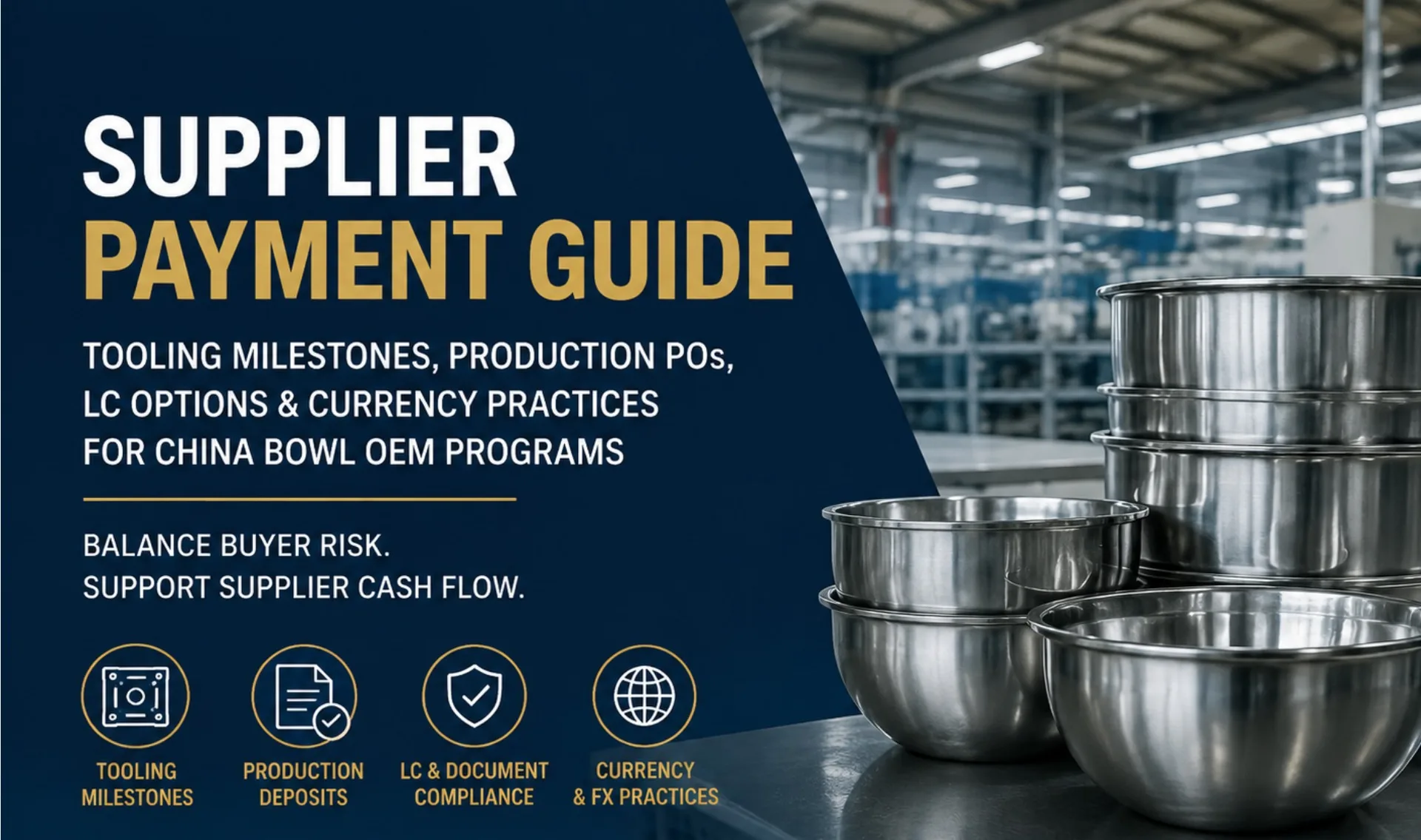
Payment terms balance buyer risk and supplier cash flow across tooling milestones and production POs. New supplier relationships need milestone-protected tooling payments and moderate production deposits; mature programs may move to net terms after shipment documentation. Avoid 100% tooling upfront without T1-linked deliverables.
This guide covers tooling splits, production deposits, letter of credit options, and currency practices for China bowl OEM programs.
Tooling payment: never 100% on order
Tie to DFM, T1 dimensional report, and golden sample per tooling milestone guide. Wire transfers should reference milestone acceptance email or signed checklist—not verbal mold complete.
See mold ownership and tooling capability.
Production PO deposits
30% deposit / 70% before ship common for new relationships—adjust after scorecard history. Large first PO may use LC to align bank release with OQC and document bundle completeness.
LC considerations
Document bundle must match LC clauses: commercial invoice, packing list, B/L, cert bundle timing. Coordinate compliance doc completion before latest presentation date—LC discrepancy delays payment and strains supplier relationship despite good product.
Currency and FX
USD common for export tooling and PO—fix FX reference date in contract if supplier accounts in CNY. Tooling and production may use same or separate currency—clarify bank charges.
Mature program evolution
After four quarters OTIF and quality targets, negotiate net 30 against trusted documentation—supplier may require volume commitment or credit insurance.
Luzhenyu Hardware operates from a ~8,000 sqm production base in Chashan Town, Dongguan, Guangdong, with 27 presses from 10T to 350T. About 90% of current capacity focuses on stand mixer bowls, with 200,000+ monthly bowl output across programs. The factory manages 60+ owned molds and 200+ customer molds under project agreements. Quality workflow follows IQC → FAI → IPQC → OQC under ISO 9001. See about Luzhenyu and deep drawing capability for factory context.
Propose payment schedule in RFQ · Bowl programs
Applying this guide in your sourcing workflow
Integrate these practices into your existing supplier onboarding gate—not as optional reading after tooling payment. Procurement, quality, and engineering should share the same checklist version so commercial quotes, audit notes, and sample approvals reference identical scope assumptions.
For stand mixer bowl programs, hub interface control and cosmetic grading drive more launch risk than minor piece-price differences. Category-focused manufacturers invest in repeat bowl IPQC because daily volume surfaces defect modes early—buyers benefit when audit and RFQ questions target that discipline.
Cross-functional alignment before factory commitment
Legal should review NDA and tooling exhibits while engineering completes DFM review—not after mold steel is cut. Logistics should confirm incoterms and pack drop requirements before golden sample sign-off so OQC and transit validation match retail expectations.
Document every gate in a shared project tracker: RFQ complete, NDA executed, audit pass, DFM signed, tooling milestone payments, T1/T2, golden sample, pilot, volume PO. Gaps in tracker visibility cause internal blame when schedules slip.
When to escalate or pause the program
Pause tooling payment if audit reveals unlabeled customer molds, missing IQC records, or unwillingness to show production similar to your geometry. Escalate to executive level when repeated hub failures occur without root cause CAPA, or when document bundles repeatedly fail retailer checklist at incoming.
Switching suppliers mid-program is costly but cheaper than launching retail with hub fit failures—plan mold custody and transfer before relationship deterioration makes retrieval adversarial.
Factory capability context for bowl OEM buyers
When evaluating Dongguan and Guangdong deep drawing suppliers, compare category focus and repeat bowl metrics—not only quoted piece price. Factories running stand mixer bowls daily maintain hub gauges, cosmetic limit samples, and mold PM logs tuned to high-volume output. Luzhenyu's Chashan base (~8,000 sqm) runs 27 presses from 10T to 350T with about 90% of capacity on mixer bowls, 200,000+ monthly output, 60+ owned molds, and 200+ customer molds under project agreements. Quality workflow follows IQC → FAI → IPQC → OQC under ISO 9001. Use this as a benchmark when auditing any shortlisted supplier, then validate with your own drawing.
Related resources: deep drawing, quality and compliance, stand mixer bowl programs, and submit an RFQ.
Linking buyer decisions to production reality
Procurement decisions on incoterms, payment terms, MOQ tiers, and supplier scorecards only work when connected to engineering gates: DFM feasibility, T1 dimensional reports, golden sample approval, and pilot validation at line speed. Skipping any gate transfers risk to the next phase—tooling disputes become sample delays, sample delays become ramp failures, and ramp failures become retail stockouts with field complaints.
Complete the OEM RFQ checklist and factory audit checklist before committing tooling budget. Pair with internal approval authority for hub fit and cosmetic sign-off so supplier iteration cycles are not lost to buyer-side review backlog.
Applying this guide in your sourcing workflow
Integrate these practices into your existing supplier onboarding gate—not as optional reading after tooling payment. Procurement, quality, and engineering should share the same checklist version so commercial quotes, audit notes, and sample approvals reference identical scope assumptions.
For stand mixer bowl programs, hub interface control and cosmetic grading drive more launch risk than minor piece-price differences. Category-focused manufacturers invest in repeat bowl IPQC because daily volume surfaces defect modes early—buyers benefit when audit and RFQ questions target that discipline.
Cross-functional alignment before factory commitment
Legal should review NDA and tooling exhibits while engineering completes DFM review—not after mold steel is cut. Logistics should confirm incoterms and pack drop requirements before golden sample sign-off so OQC and transit validation match retail expectations.
Document every gate in a shared project tracker: RFQ complete, NDA executed, audit pass, DFM signed, tooling milestone payments, T1/T2, golden sample, pilot, volume PO. Gaps in tracker visibility cause internal blame when schedules slip.
Frequently asked questions
Is LC required for first PO?
Not always—depends on buyer credit policy and PO size; common above high six figures.
Should tooling and production use same payment method?
Can differ—tooling milestones vs shipment-triggered production balance.
Who pays bank fees?
Define in contract—SWIFT fees split or borne by buyer common.
Can I withhold balance for quality dispute?
Only per contract dispute clause—unilateral withhold damages trust and LC compliance.
Are PayPal or informal channels acceptable?
Avoid for tooling scale—use bank wire with milestone trail.
Send your drawing for DFM review
Even a rough print, target volume, and finish requirement are enough for a go/no-go and next-step reply within one business day.
Typical first response within 1 business day (WhatsApp often faster for Asia/EU time zones).
Explore more