case study
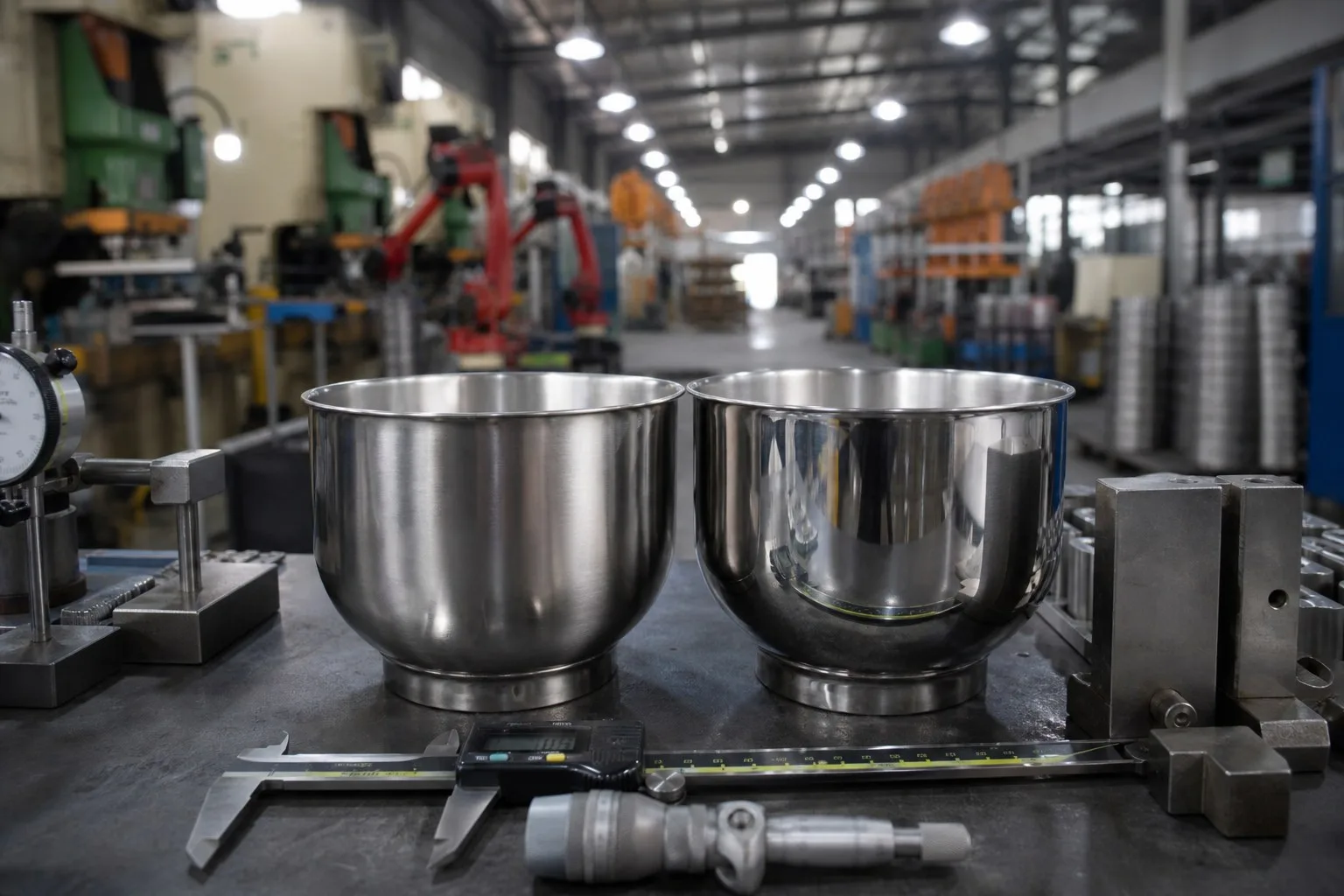
Food Processor Bowl Deep Drawing Case Study: Why a Two-Pass Process Replaced Single-Pass Forming
Have a similar program?
Tell us your part type, hub or weld requirements, and annual volume tiers — we will outline a reference program path, not a stock SKU quote.
Customer identity withheld under NDA. This reference explains engineering and production logic for a food processor–class bowl shell with higher draw ratio than a typical stand mixer bowl. It is not a catalog SKU for immediate order.
Read this if your shell is deep relative to diameter and you need to understand when multi-pass deep drawing replaces a single-pass route—and how thickness mapping justifies tooling decisions before mass production.
Design constraint that drove DFM
The shell height-to-diameter ratio exceeded the safe single-pass envelope used on many tilt-head mixer bowls in Luzhenyu's repeat production category. Initial trial forming on experimental setup showed:
- Localized wall thinning above the base radius
- Early crack initiation at punch profile under continued single-pass pressure
- Rim ovality drift when blank holder force was reduced to avoid tear
DFM conclusion: force single-pass for speed would raise scrap at volume; a planned two-pass sequence with intermediate trim was the lower-risk production route.
Two-pass route (what each pass does)
Pass 1 — Cup formation: Establish primary diameter and partial depth; control wrinkling with blank holder and lubrication settings documented in process sheet.
Intermediate trim: Remove excess flange material that would interfere with second draw metal flow.
Pass 2 — Depth extension: Achieve final shell height while managing work hardening in the approved 304 coil batch; FAI includes thickness map at base, mid-wall, and rim.
Hub features were minimal on this geometry; critical characteristics were wall thickness distribution and rim roundness—not drive tab engagement.
Tooling and mold governance
Customer-funded mold stored under project agreement, labeled and segregated from 60+ owned reference molds at the Chashan base. Trim tooling and polish handling fixtures added to scope after T1—not omitted from initial quote to win price.
Maintenance log recorded punch radius polish wear every 50,000 pieces during pilot and early mass production. Scheduled touch-ups prevented sudden cosmetic defect spikes that masquerade as "operator variation."
Thickness mapping as approval evidence
T1 samples measured wall thickness at agreed heights; results shared with buyer to justify two-pass route versus cheaper single-pass retry. Rim roundness and draw depth tracked across pilot batches demonstrated stability before mass release authorization.
FAI repeated after any die maintenance affecting draw depth—documented on setup ID tied to production lot.
Quality and cosmetic control
- IQC: Lock grade and gauge to T2-approved coil source
- IPQC: AQL on polish scratches and handling marks post-automatic polish line
- OQC: Rim roundness sample + lot ID for EU channel incoming
Automatic polish line adopted only after pilot defect modes were stable—manual polish during pilot to isolate root causes.
EU channel documentation (scoped)
Buyer required food-contact and substance documentation per agreed laboratory methods for European private-label channel—not a generic factory folder of unrelated reports. Test scope locked in PO before mass production; lot linkage on shipment bundle.
See food-contact compliance guide for timing expectations.
Contrast with single-pass mixer bowl programs
Luzhenyu runs high-volume stand mixer bowls—200,000+ monthly across programs, ~90% capacity in bowl category—often on single-pass routes when depth-to-diameter fits reference envelope. Processor-class shells with taller sidewalls frequently require multi-pass sequencing. Do not assume one process fits all bowl drawings.
Buyer decision checklist (deep shells)
- Request written single-pass vs multi-pass recommendation before tooling PO
- Require T1 thickness map, not only pass/fail photos
- Agree mold maintenance interval for deep draws
- Lock compliance scope in RFQ for destination market
- Review 304 cracking DFM with your drawing attached
Representative timeline
- Weeks 1–2: DFM, single-pass trial, two-pass approval
- Weeks 3–9: Tooling, T1 map, die correction
- Weeks 10–11: T2, pilot, cosmetic AQL lock
- Week 12+: Mass production, maintenance every ~50k pcs
Common buyer mistakes on deep shells
- Paying tooling before seeing single-pass trial outcome
- Accepting supplier claims of "same as mixer bowl process" without thickness data
- Skipping trim tooling in quote comparison—hidden cost appears at T1
- Adding EU compliance scope after pilot without retest budget
Process controls held constant in mass production
After pilot, the supplier documented lubrication type, blank holder pressure range, and press tonnage class for each pass. IPQC verified rim roundness on interval sample; any die maintenance triggered mandatory FAI on thickness map before batch continuation. This discipline prevents "silent drift" where shells slowly thin at base without immediate crack—failures that appear at distributor incoming instead of at factory OQC.
Volume ramp after route lock
Once two-pass route and thickness map were buyer-approved, pilot batches ran at 30–40% of planned weekly rate while IPQC refined polish defect grading. Steady-state release required three consecutive pilot lots within agreed rim and thickness bands. Only then did scheduling align with the buyer's EU channel fill window—avoiding the common mistake of authorizing full press allocation before cosmetic AQL was stable on automatic polish.
Coil behavior and batch-to-batch stability
304 elongation varied between incoming coil lots even within the same grade specification. IQC retained a small coupon from each approved lot for reference if IPQC saw crack-rate drift mid-batch. When a new coil lot arrived, engineering ran a shortened first-off check on draw force and rim roundness before full batch release—especially after mold maintenance. This prevented the common failure mode where a "good" die suddenly produces tears because coil hardness shifted, not because punch radius wore overnight.
For programs targeting EU private label, lot traceability linked coil heat number to OQC report and compliance documentation on each shipment—buyers could answer retailer audits without reconstructing records from generic factory certificates.
Questions to ask on a similar RFQ
- Will you trial single-pass before committing to multi-pass tooling cost—and share thickness map either way?
- Are intermediate trim dies included in tooling scope or quoted separately?
- What mold maintenance interval applies at our forecast volume (e.g., every 50,000 pieces)?
- How is automatic polish qualified before switching from manual pilot polish?
- Which compliance tests are scoped to this SKU and destination market—not unrelated legacy reports?
Frequently asked questions
Is a food processor shell always multi-pass?
Not always—but height-to-diameter ratio and corner radius drive the decision. Shallow processor bowls may remain single-pass within Luzhenyu's reference envelope (approximately 10–350 mm diameter, 0–250 mm draw height, subject to DFM). Taller shells with aggressive base radii often need two-pass sequencing with intermediate trim.
How does this program differ from stand mixer bowl volume production?
Mixer bowls at 200,000+ monthly output typically use routes optimized for hub fit, rim roundness, and cosmetic grading on repeat single-pass geometry. Processor shells prioritize wall thickness maps and draw-depth stability; hub features may be minimal. Process and IPQC emphasis differ—do not assume identical inspection plans.
When should buyer approve automatic polish?
After pilot lots stabilize defect modes on manual or semi-automatic polish and AQL limits are agreed with signed samples. Switching too early hides handling scratches that appear only at line speed.
Can owned reference molds shorten lead time?
Only when DFM confirms geometry overlap with an existing die envelope. Customer-funded molds remain the norm for unique shell profiles; Luzhenyu maintains 60+ owned molds and 200+ customer molds under project agreements—owned molds accelerate feasibility review but do not replace hub- or depth-specific engineering sign-off.
Related DFM resources
Pair this reference with deep drawing manufacturer evaluation when selecting a supplier for deep shells—not only price comparison on shallow bowl benchmarks.
Deep drawing capability · Appliance programs · Request shell DFM review
Have a similar program?
Tell us your part type, hub or weld requirements, and annual volume tiers — we will outline a reference program path, not a stock SKU quote.
Typical first response within 1 business day (WhatsApp often faster for Asia/EU time zones).
Explore more