
quality guide
Weld Inspection for Laser-Welded Bowl Handles
Send your drawing for DFM review
Even a rough print, target volume, and finish requirement are enough for a go/no-go and next-step reply within one business day.
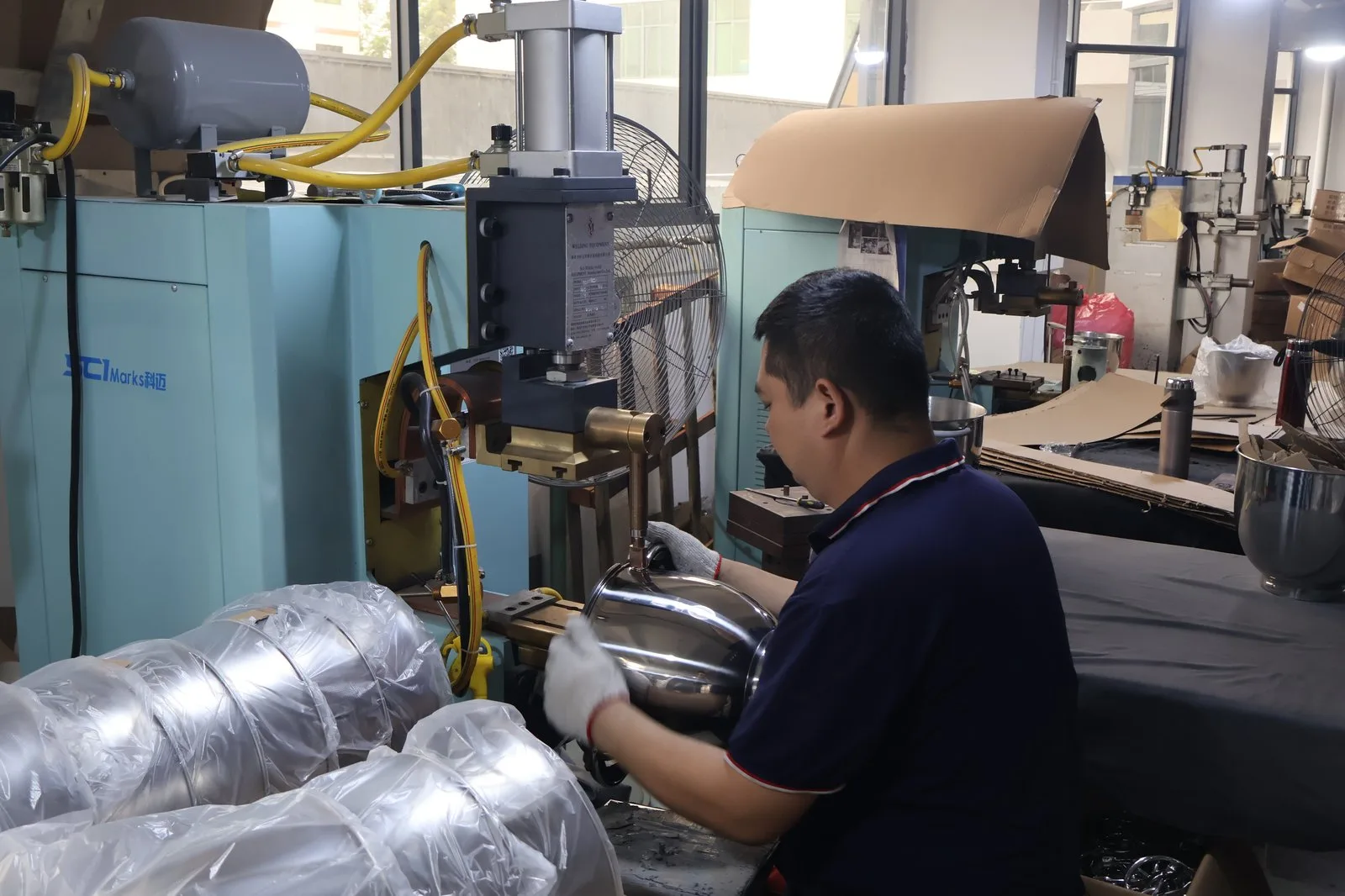
Laser welds attaching stainless handles to deep-drawn mixer bowls must satisfy mechanical load expectations and cosmetic standards under retail lighting. Inspection plans should combine visual criteria with defined lighting, periodic destructive sampling for penetration verification, fixture alignment checks after weld tip wear, and clear rework versus scrap rules—unauthorized touch-up welds are a common hidden failure mode on high-volume handle bowl lines.
This guide covers visual weld acceptance, destructive sampling frequency, fixture maintenance linkage to IPQC, and coordination with passivation and polish sequences.
Visual criteria and photo standards
Define limits for undercut, porosity visible at magnification agreed in PO, crack length, weld width variation, and heat tint color on stainless. Photos on signed sample under same light box as cosmetic defect catalog. Handle weld zone often allows discoloration levels forbidden on mirror bowl face—zone rules prevent misapplication.
Destructive sampling for penetration
Periodic cross-section or peel/shear tests at frequency tied to batch size or AQL supplemental plan. Document weld penetration depth and fusion line on metallurgical photo. Spike in destructive fail rate triggers stop-line and fixture PM review per IPQC guide.
Fixture maintenance and misalignment
Handle weld fixtures drift from wear and bowl dimensional variation within tolerance. Misalignment causes intermittent weak welds IPQC may miss if sampling too sparse. PM log for fixture pins, clamp pressure, and laser focus should link to weld defect Pareto. Review laser welding capability during audit.
Repair and rework rules
Define whether secondary weld pass, grind, or polish rework is allowed or part must scrap. Unauthorized operator touch-up without QC release creates audit liability and dishwasher validation risk per dishwasher validation guide.
Sequence with passivation and polish
Weld inspection timing may be before final mirror polish and before passivation when required—see passivation guide. Final OQC includes handle tug test if PO specifies torque or pull load.
Link to FAI on new handle programs per FAI guide. Review quality and compliance, mixer programs, bowl QC pillar, and contact for quote.
Frequently asked questions
Is 100% visual weld inspection required?
Many programs use 100% visual with statistical destructive sampling—define in PO.
Can laser weld replace riveted handles for retail?
Yes when load validation and cosmetic standards met—validate on FAI.
Does weld inspection appear on OQC report?
Include handle weld pass/fail and destructive sample reference when in scope.
How handle weld affects LFGB sample?
Food-contact test sample should include weld zone when handle attached—see LFGB scope.
What load test for handle?
Buyer platform spec or internal standard—document on FAI before mass production.
Laser parameter log review during audit
Auditors should sample laser weld parameter log: power, pulse width, travel speed, shield gas flow—for destructive-fail batch correlation. Unauthorized parameter change without IPQC notice explains intermittent weak weld clusters invisible to 100% visual when undercut subtle.
Parameter log linked to batch ID same as coil traceability discipline.
Handle pull test fixture design
Pull test fixture must apply force at consumer-realistic angle and attachment point—not pure vertical lift only if consumer failure mode is torsion during mixer use. Buyer platform spec should include force, angle, cycle count, and acceptance—document on FAI.
Failed pull test triggers weld fixture alignment check before second destructive round per laser welding capability. See FAI guide and contact for handle load spec review.
Weld spatter and clean-up acceptance
Laser spatter on mirror face outside weld zone may be major cosmetic defect while acceptable on brushed handle attachment zone—catalog must show spatter examples with zone labels. Unauthorized grinder touch-up to remove spatter can create worse haze than original spatter.
Define spatter removal permission in PO same as rework weld rules per cosmetic grading.
Ultrasonic or X-ray weld examination for premium programs
Premium appliance programs may specify ultrasonic examination on statistical sample beyond visual and destructive cross-section—scope costly and slow, reserved for high-liability SKUs. PO should state NDE method, sample size, and acceptance criteria or explicitly waive NDE to avoid buyer assuming included.
NDE report attaches to FAI file and repeats on schedule (e.g., quarterly) for long programs with handle weld failure history.
Handle material grade match to bowl body
Handle stainless grade should match or exceed bowl body corrosion expectation—304 handle on 201 bowl may create galvanic or cosmetic mismatch in corrosion test. MTC for handle wire separate from bowl coil in trace file when grades differ by design.
Grade mismatch documentation in FAI when buyer approves mixed grade assembly intentionally.
Buyer action summary for handle weld QC
Define visual, destructive, and pull-test requirements on FAI; photo-standard discoloration limits; fixture PM log review; rework/scrap rules; include weld zone in LFGB sample when attached.
Handle weld failure consumer complaint triage
When consumer sends photo of handle separation, trace batch via date code and compare to destructive sampling schedule that week—gap indicates sampling frequency too sparse for detected failure mode.
Parameter log audit during factory visit. Laser welding capability and handle load spec RFQ.
Are adhesive-bonded handles in scope of this guide?
No—this guide addresses laser welded metal handles. Adhesive programs need separate bond shear and aging test protocol.
Should weld inspection include handle alignment to bowl axis?
Yes when cosmetic symmetry specified on signed sample—angular misalignment is major defect even when weld strength passes.
Does laser weld filler wire grade require separate MTC?
When filler differs from bowl body grade—yes, trace filler MTC in weld destructive sample file for corrosion and compliance audit.
Questions on weld QC scope: contact engineering with handle attachment drawing.
Closing notes for sourcing teams
Handle weld quality is invisible until it fails in the consumer kitchen—destructive sampling and fixture PM are cheap compared to brand recall headlines. Pull test angle should mimic worst-case consumer loading, not laboratory convenience.
For first handle-weld SKU on a bowl line, double destructive sampling frequency during first three production batches until weld Pareto stabilizes below agreed control limit.
Program note for weld inspection laser welded bowl handles: lock scope in PO appendix, audit supplier records at qualification, and align IQC through OQC with compliance files before volume scale-up.
Send your drawing for DFM review
Even a rough print, target volume, and finish requirement are enough for a go/no-go and next-step reply within one business day.
Typical first response within 1 business day (WhatsApp often faster for Asia/EU time zones).
Explore more