
compliance guide
Material Certificate Requirements by Market for Stainless OEM Parts
Send your drawing for DFM review
Even a rough print, target volume, and finish requirement are enough for a go/no-go and next-step reply within one business day.
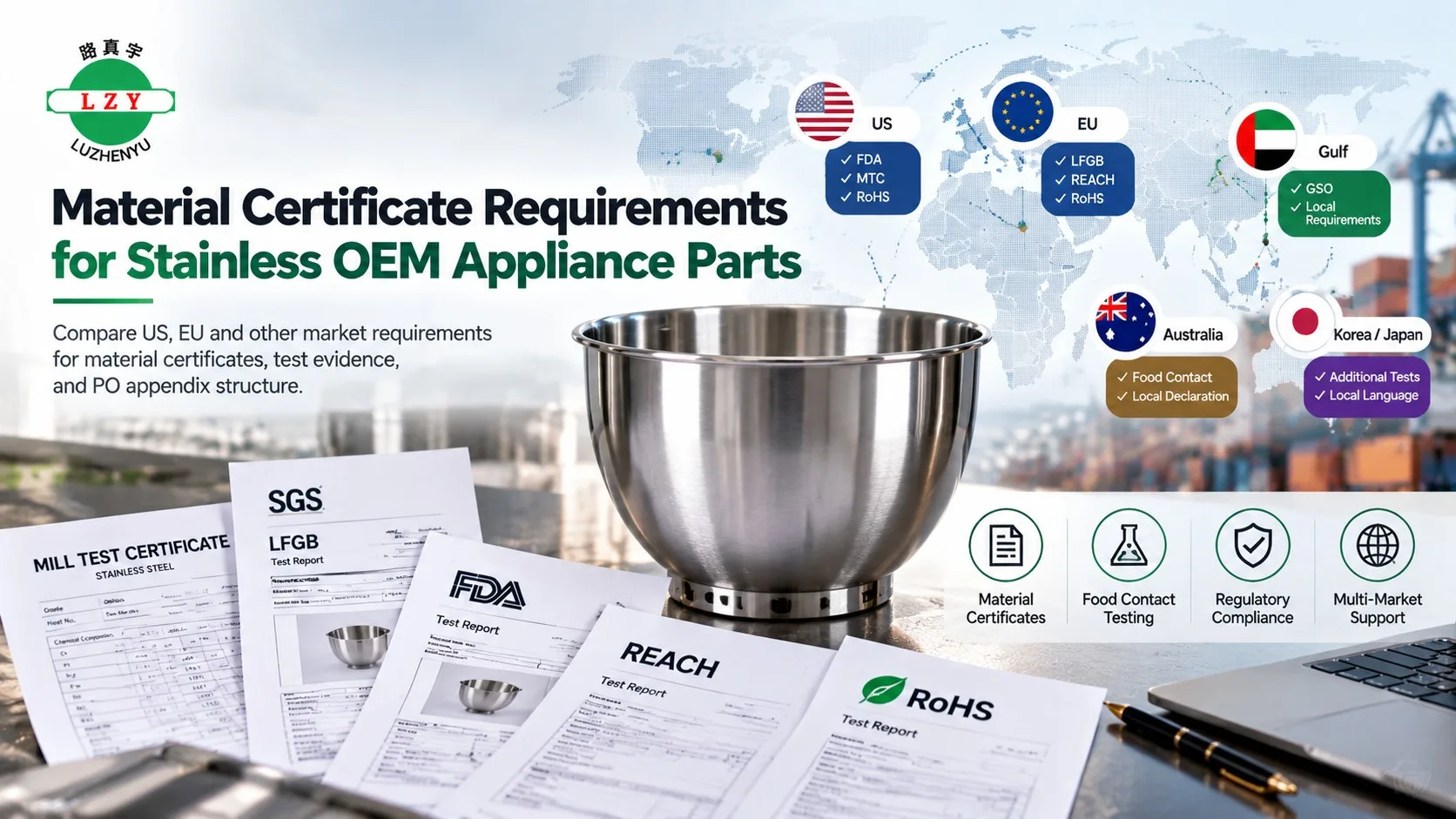
Material certificate requirements for stainless OEM appliance parts vary by buyer, sales channel, and destination market—not by country alone. A US private label retailer, EU discounter, Gulf distributor, and HORECA wholesaler may require different certificate bundles for the same physical mixer bowl geometry. Mapping requirements during RFQ prevents tooling payment before compliance scope is priced and staffed.
This guide compares US, EU, and other market patterns for material certificates, test evidence, and PO appendix structure.
US market patterns
US retail and brand programs commonly combine 304 or agreed grade specification with mill test certificate traceability, FDA-oriented food-contact migration or constituent testing language, retailer proprietary compliance portal uploads, RoHS data when corporate policy extends to kitchen SKUs, and OQC lot linkage on recurring lines. Generic "FDA compliant factory" statements without SKU reports fail onboarding.
See FDA food-contact documentation and RoHS guide.
EU market patterns
EU private label and retail often require LFGB-scoped migration testing, REACH SVHC declaration or screening, RoHS for EEE-context products, material declaration templates specific to large retailers, and batch or periodic retest rules on long programs. CE marking context may apply when bowl ships as part of appliance assembly—buyer legal defines.
See LFGB scope and REACH documentation.
Other markets: Gulf, Australia, Korea, Latin America
Gulf markets may add GSO or local conformity marks for certain channels. Australia and New Zealand buyers sometimes reference FDA or EU evidence plus local importer declarations. Korea and Japan retail may require additional migration methods or language-specific certificates. Confirm before tooling—not after first shipment rejection.
Channel variation within same country
US HORECA distributor may accept MTC plus supplier declaration where US big-box retail requires full third-party migration report to buyer name. EU industrial catering may relax LFGB renewal frequency versus EU supermarket private label. Build PO appendix table per channel row—not one-size document list.
PO appendix structure
Table columns: document name, format, issuing party, validity period, lot linkage rule, renewal responsibility, and due date relative to ship. Tie to IQC grade lock and export checklist. Grade selection per 304 vs 201 guide affects which certificates remain valid after material change.
Review quality and compliance, food-contact compliance, appliance parts, mixer programs, and RFQ contact.
Frequently asked questions
Is one LFGB report valid globally?
EU-focused; US buyers may not accept it as sole food-contact evidence.
Can MTC satisfy all markets?
MTC is baseline material proof—most retail channels need additional tests.
Who pays for market-specific retests?
Allocate in PO before production—surprise cost causes margin loss.
How often renew certificates on recurring PO?
Define per document type in appendix—annual vs per batch.
Does ISO 9001 certificate replace product tests?
No—system cert supports process; product evidence is separate.
Private label versus national brand documentation depth
National appliance brands sometimes maintain internal substance databases accepting supplier declaration with periodic audit. Private label retailers often mandate fresh third-party report naming retailer as beneficiary each season—same bowl geometry, different document depth and cost.
RFQ should state private label versus brand OEM path to avoid under-quoting documentation labor.
Renewal calendar management on five-year programs
Multi-year OEM agreements need compliance calendar: LFGB renewal month, REACH re-sign quarterly review, RoHS annual refresh, MTC per heat (ongoing), dishwasher revalidation if packaging claim changes. Assign owner on buyer and supplier side in quality agreement meeting minutes.
Missed renewal discovered at shipment gate—not during calm mid-year review. Tools: shared spreadsheet indexed to SKU and report expiry date linked to batch traceability.
Importer legal entity naming on certificates
Many markets require certificate beneficiary name to match importer of record—not factory, not buyer HQ if different from importer. RFQ should list legal entity names for each destination country when multi-importer model used.
Re-issuance delay from wrong entity name on LFGB report is preventable PO field.
Language and notarization requirements
Gulf and Latin American importers sometimes require Arabic or Spanish translation notarized—scope in RFQ before quoting $800 translation plus legal fee not in original margin. English-only MTC fails local customs although US retailer accepted same file.
Translation vendor with prior kitchenware compliance experience reduces rejection cycles on technical terms.
E-commerce marketplace simplified compliance
Amazon or marketplace sellers sometimes accept reduced doc set versus big-box retail—supplier should not assume one bundle satisfies all channels buyer sells. Marketplace may require CPSIA-adjacent declarations even for metal bowl when listed in baby category erroneously.
Channel-specific appendix rows prevent over-documenting marketplace while under-documenting retail.
Audit frequency by market risk tier
High-risk EU supermarket tier-one may audit supplier annually; HORECA tier-three may audit once at onboarding—certificate refresh frequency should match audit tier not universal annual LFGB for all channels.
Buyer action summary for multi-market certs
Build PO appendix table by channel and country; assign renewal owner; separate private label depth from HORECA minimum; budget translation/notarization where required. Amortize compliance cost in unit economics.
Certificate expiry dashboard shared with supplier
Shared cloud calendar with report expiry dates visible to both buyer and supplier quality teams prevents surprise ship hold when LFGB expires same week as promotional PO—supplier sees renewal task 90 days ahead.
Align grade lock before cert scope. See quality and compliance and OEM RFQ checklist.
Do HORECA distributors always need LFGB?
Not always—many accept MTC plus supplier declaration. Confirm with distributor compliance contact before assuming full retail doc stack.
When add Gulf or Australia certs to PO appendix?
During RFQ when destination country confirmed—retrofit cert scope after tooling payment compresses lab schedule before first ship.
Can one PO appendix row cover all Asian markets?
Rarely—Korea, Japan, and China each may add unique migration method or language—use separate rows per country group.
Closing notes for sourcing teams
Market-specific cert maps belong in sourcing playbook beside landed cost models—same SKU, different channel, different file stack and different margin. Review cert map when buyer opens new country distributor—not only at initial SKU launch.
When buyer adds a new distributor country mid-program, trigger cert gap review within five business days—do not assume existing US-plus-EU file satisfies new destination without legal confirmation.
Program note for material certificate requirements by market: lock scope in PO appendix, audit supplier records at qualification, and align IQC through OQC with compliance files before volume scale-up.
Send your drawing for DFM review
Even a rough print, target volume, and finish requirement are enough for a go/no-go and next-step reply within one business day.
Typical first response within 1 business day (WhatsApp often faster for Asia/EU time zones).
Explore more