
buyer guide
Dispute Resolution for Defective Stainless Bowl Batches
Send your drawing for DFM review
Even a rough print, target volume, and finish requirement are enough for a go/no-go and next-step reply within one business day.
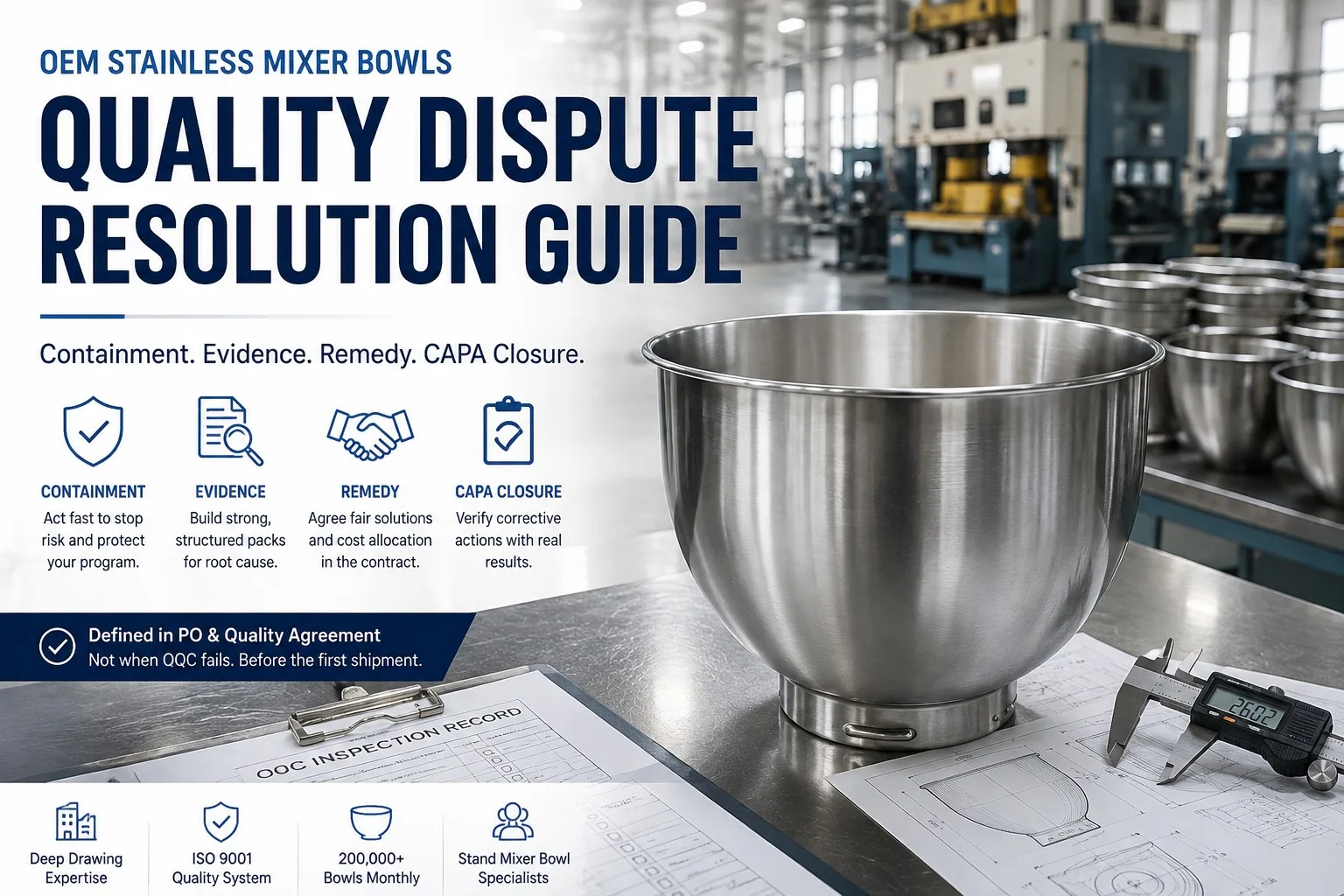
Defective stainless bowl batches occur even with capable suppliers—dispute process determines relationship survival and retail exposure. PO and quality agreement should define containment, sort cost allocation, root cause CAPA timeline, and credit/rework formula before first shipment—not when OQC fails under launch pressure.
Immediate containment within 24 hours
Stop ship on affected lot or suspect lots sharing coil heat or mold setup. Segregate inventory at supplier and buyer warehouse. Agree batch ID trace scope—hub fails may implicate same FAI setup ID across multiple cartons.
Evidence pack for root cause
- Photos under agreed cosmetic light
- OQC AQL record and hub gauge data
- Coil lot and heat number from IQC log
- IPQC patrol sheets for setup ID
- Pack damage assessment if transit excluded
Share pack before blame assignment. See quality and compliance and bowl QC guide.
Remedy options and pricing
Define in contract: sort at supplier vs buyer, rework polish limits, remake lot, credit note formula (% of lot value vs PPM tier). Hub functional fails rarely justify rework polish alone—scrap and remake may be only safe path.
CAPA closure criteria
Corrective action verified on next batch FAI with enhanced patrol—not closed by email promise. Buyer quality signs CAPA effectiveness after verification shipment. Recurring same defect code triggers scorecard escalation and dual-source review.
Prevention in PO appendix
Signed golden sample, limit samples, critical dimension list, OQC format, and dispute escalation timeline—linked to RFQ checklist quality section.
Luzhenyu Hardware operates from its Dongguan production base in Chashan Town, Dongguan, Guangdong, with project-matched forming presses. Stand mixer bowls represent a major share of customer programs, with 250,000+ stand mixer bowls produced per year as a reference output produced per year as a reference output produced per year as a reference output produced per year as a reference output produced per year as a reference output produced per year as a reference output produced per year as a reference output produced per year as a reference output produced per year as a reference output. The factory manages 200+ tooling development references across customer projects and customer-funded tooling managed under project agreements under project agreements. Quality workflow follows IQC → FAI → IPQC → OQC; certification status and scope should be verified separately. See about Luzhenyu and deep drawing capability for factory context.
Mixer bowl programs · Quality agreement template discussion
Applying this guide in your sourcing workflow
For dispute resolution for defective stainless bowl batches, define the acceptance method and record owner before the part reaches the next gate. Integrate these practices into your existing supplier onboarding gate—not as optional reading after tooling payment. Procurement, quality, and engineering should share the same checklist version so commercial quotes, audit notes, and sample approvals reference identical scope assumptions.
For buyers reading dispute resolution for defective stainless bowl batches, use this point to compare supplier evidence before comparing price. For stand mixer bowl programs, hub interface control and cosmetic grading drive more launch risk than minor piece-price differences. Category-focused manufacturers invest in repeat bowl IPQC because daily volume surfaces defect modes early—buyers benefit when audit and RFQ questions target that discipline.
Cross-functional alignment before factory commitment
In dispute resolution for defective stainless bowl batches, apply this DFM check to the actual geometry, material, and trial result rather than to a generic capability claim. Legal should review NDA and tooling exhibits while engineering completes DFM review—not after mold steel is cut. Logistics should confirm incoterms and pack drop requirements before golden sample sign-off so OQC and transit validation match retail expectations.
For dispute resolution for defective stainless bowl batches, separate what the first sample proves from what still needs production-tool validation. Document every gate in a shared project tracker: RFQ complete, NDA executed, audit pass, DFM signed, tooling milestone payments, T1/T2, golden sample, pilot, volume PO. Gaps in tracker visibility cause internal blame when schedules slip.
When to escalate or pause the program
For dispute resolution for defective stainless bowl batches, put the tooling boundary and custody decision in writing before steel or payment is released. Pause tooling payment if audit reveals unlabeled customer molds, missing IQC records, or unwillingness to show production similar to your geometry. Escalate to executive level when repeated hub failures occur without root cause CAPA, or when document bundles repeatedly fail retailer checklist at incoming.
For dispute resolution for defective stainless bowl batches, put the tooling boundary and custody decision in writing before steel or payment is released. Switching suppliers mid-program is costly but cheaper than launching retail with hub fit failures—plan mold custody and transfer before relationship deterioration makes retrieval adversarial.
Factory capability context for bowl OEM buyers
For dispute resolution for defective stainless bowl batches, define the acceptance method and record owner before the part reaches the next gate. When evaluating Dongguan and Guangdong deep drawing suppliers, compare category focus and repeat bowl metrics—not only quoted piece price. Factories running stand mixer bowls daily maintain hub gauges, cosmetic limit samples, and mold PM logs tuned to high-volume output. Luzhenyu's Chashan base (our Dongguan production base) runs project-matched forming presses with stand mixer bowls represent a major share of customer programs, 250,000+ stand mixer bowls produced per year as a reference output produced per year as a reference output produced per year as a reference output produced per year as a reference output produced per year as a reference output produced per year as a reference output produced per year as a reference output produced per year as a reference output produced per year as a reference output, 200+ tooling development references across customer projects, and customer-funded tooling managed under project agreements under project agreements. Quality workflow follows IQC → FAI → IPQC → OQC; certification status and scope should be verified separately. Use this as a benchmark when auditing any shortlisted supplier, then validate with your own drawing.
Related resources: deep drawing, quality and compliance, stand mixer bowl programs, and submit an RFQ.
Linking buyer decisions to production reality
For dispute resolution for defective stainless bowl batches, separate what the first sample proves from what still needs production-tool validation. Procurement decisions on incoterms, payment terms, MOQ tiers, and supplier scorecards only work when connected to engineering gates: DFM feasibility, T1 dimensional reports, golden sample approval, and pilot validation at line speed. Skipping any gate transfers risk to the next phase—tooling disputes become sample delays, sample delays become ramp failures, and ramp failures become retail stockouts with field complaints.
For buyers reading dispute resolution for defective stainless bowl batches, use this point to compare supplier evidence before comparing price. Complete the OEM RFQ checklist and factory audit checklist before committing tooling budget. Pair with internal approval authority for hub fit and cosmetic sign-off so supplier iteration cycles are not lost to buyer-side review backlog.
Applying this guide in your sourcing workflow
For dispute resolution for defective stainless bowl batches, define the acceptance method and record owner before the part reaches the next gate. Integrate these practices into your existing supplier onboarding gate—not as optional reading after tooling payment. Procurement, quality, and engineering should share the same checklist version so commercial quotes, audit notes, and sample approvals reference identical scope assumptions.
For buyers reading dispute resolution for defective stainless bowl batches, use this point to compare supplier evidence before comparing price. For stand mixer bowl programs, hub interface control and cosmetic grading drive more launch risk than minor piece-price differences. Category-focused manufacturers invest in repeat bowl IPQC because daily volume surfaces defect modes early—buyers benefit when audit and RFQ questions target that discipline.
Cross-functional alignment before factory commitment
In dispute resolution for defective stainless bowl batches, apply this DFM check to the actual geometry, material, and trial result rather than to a generic capability claim. Legal should review NDA and tooling exhibits while engineering completes DFM review—not after mold steel is cut. Logistics should confirm incoterms and pack drop requirements before golden sample sign-off so OQC and transit validation match retail expectations.
For dispute resolution for defective stainless bowl batches, separate what the first sample proves from what still needs production-tool validation. Document every gate in a shared project tracker: RFQ complete, NDA executed, audit pass, DFM signed, tooling milestone payments, T1/T2, golden sample, pilot, volume PO. Gaps in tracker visibility cause internal blame when schedules slip.
Frequently asked questions
Should buyer pay sort cost for supplier-caused defects?
Typically supplier—define in PO; buyer-caused drawing error different path.
Can defective lot ship with concession?
Only written concession for non-critical cosmetic—hub fails block ship.
What if root cause is coil supplier?
Supplier IQC accountability to buyer unless buyer specified alternate coil source.
How long CAPA should take?
Define 30–60 days typical; interim containment until verified.
Does ISO 9001 require CAPA?
Yes systemically—buyer still defines acceptance evidence for their SKU.
Send your drawing for DFM review
Even a rough print, target volume, and finish requirement are enough for a go/no-go and next-step reply within one business day.
Typical first response within 1 business day (WhatsApp often faster for Asia/EU time zones).
Explore more