buyer guide
NDA Before Sharing Mixer Bowl Drawings with China Suppliers
Send your drawing for DFM review
Even a rough print, target volume, and finish requirement are enough for a go/no-go and next-step reply within one business day.
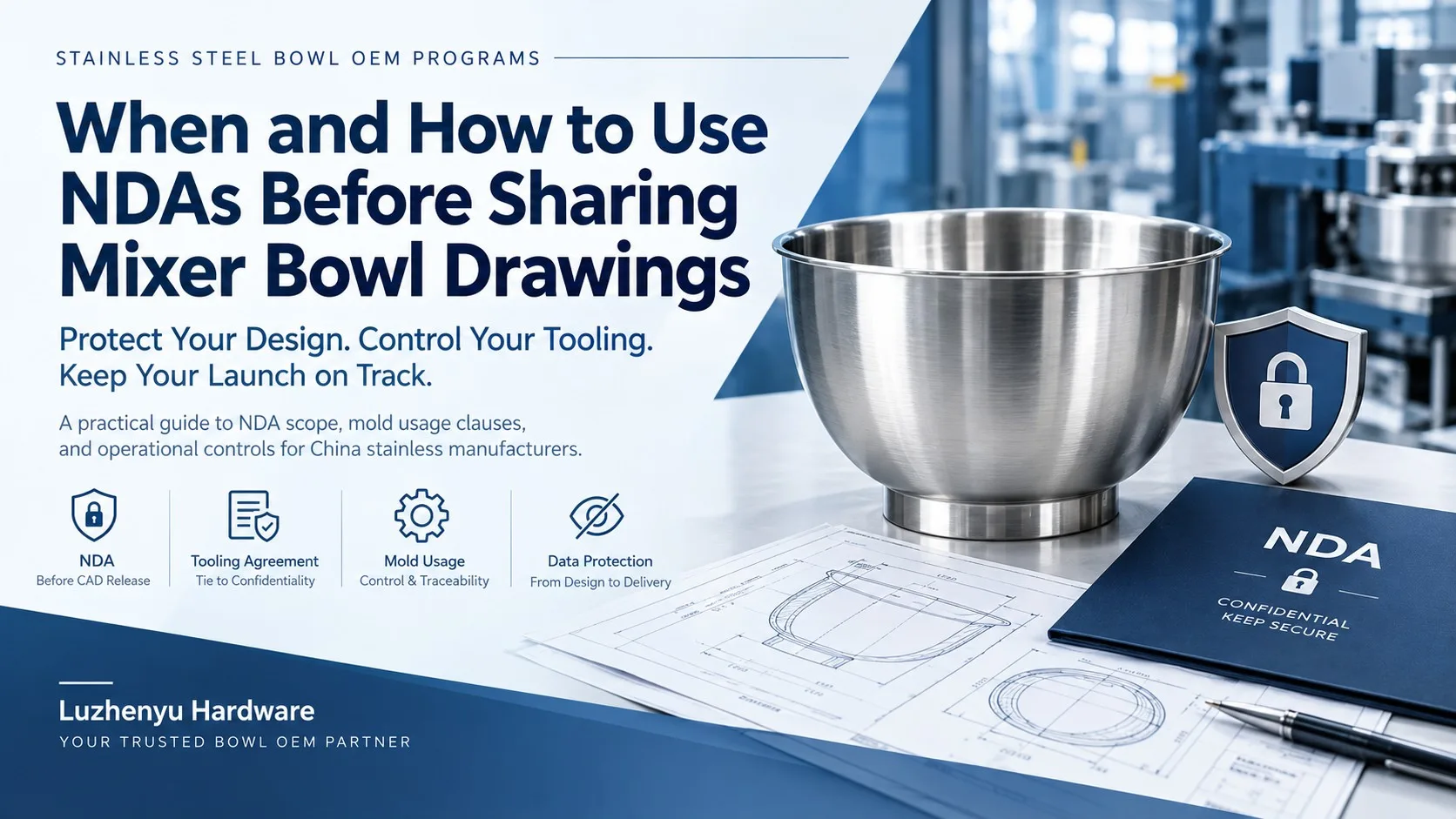
Hub geometry, brand industrial design, and retail launch volumes are competitive assets in stand mixer bowl OEM programs. Sharing CAD before contractual protection exposes buyers to mold duplication risk, unauthorized production for third parties, and leakage of forecast data through supplier networks. NDA and mold usage clauses should gate drawing release—not follow it as an afterthought.
Category-focused factories like Luzhenyu in Chashan, Dongguan often run multiple bowl programs under separate NDAs simultaneously. Clear scope prevents accidental cross-contamination of hub data between projects sharing similar rim families on the production floor.
Pre-CAD gate: no STEP files until NDA executes
Establish a hard rule: no hub STEP files, no internal assembly drawings showing drive interface, and no retailer volume forecasts until mutual NDA is signed by authorized entities on both sides. Include affiliates, mold shops, and polish subcontractors if they receive confidential files. Verbal confidentiality is insufficient for tooling programs where customer-funded molds cost tens of thousands of dollars.
NDA should define confidential information: 2D/3D drawings, BOM hints, branding artwork, pricing, retailer names, forecast tiers, and golden sample dimensions. Exclude supplier generic deep drawing know-how that is not specific to your program.
NDA scope clarity for bowl programs
- Define term length and survival period for drawings after relationship ends
- Specify permitted use: quotation, DFM, tooling build, production for buyer POs only
- Address return or destruction of CAD upon termination
- Cover photos and videos of golden samples as confidential
- Clarify whether supplier may retain DFM notes derived from your geometry
Pair NDA with tooling ownership exhibit for customer-funded molds. See mold ownership guide and tooling capability.
Mold usage tie-in and production restriction
NDA alone does not prevent unauthorized production if mold usage is undefined. Tooling agreement should state customer-funded molds produce only buyer POs, stored under labeled project code, with quarterly photo inventory if contract requires. Luzhenyu manages customer-funded tooling managed under project agreements under project agreements with segregated storage—buyers should verify similar discipline at any shortlisted supplier.
Mold labeling with buyer project code and PO reference creates audit trail linking physical tooling to contractual restriction. Unlabeled customer molds in shared racks are an IP incident waiting to happen.
CAD access minimization
Release need-to-know files only: hub interface and bowl envelope—not full appliance CAD. Watermark PDFs with date and recipient. Track revision numbers in every transmission. Single buyer engineering window prevents conflicting markups reaching supplier CNC paths.
Before sharing, complete internal RFQ checklist so first release is coherent—not iterative dribble of partial files that expand exposure surface.
Breach response and audit rights
Define escalation: notice period, mold storage verification visit rights, and cessation of production pending investigation. Document mold IDs and storage location at NDA signing baseline. If relationship sours, mold retrieval depends on condition reports prepared before dispute—not after.
Trading companies posing as factories increase IP risk because CAD may pass through entities that do not control mold room access. Prefer factory-direct relationships for hub-critical programs; see deep drawing manufacturer guide.
NDA timing in sourcing workflow
- Shortlist suppliers via capability review and virtual audit
- Execute NDA with producing entity (not agent only)
- Release controlled drawing package under revision control
- Receive DFM and tooling quote under same confidentiality frame
- Execute tooling agreement before tooling payment milestone
Luzhenyu Hardware operates from its Dongguan production base in Chashan Town, Dongguan, Guangdong, with project-matched forming presses. Stand mixer bowls represent a major share of customer programs, with 250,000+ stand mixer bowls produced per year as a reference output produced per year as a reference output produced per year as a reference output produced per year as a reference output produced per year as a reference output produced per year as a reference output produced per year as a reference output produced per year as a reference output produced per year as a reference output. The factory manages 200+ tooling development references across customer projects and customer-funded tooling managed under project agreements under project agreements. Quality workflow follows IQC → FAI → IPQC → OQC; certification status and scope should be verified separately. See about Luzhenyu and deep drawing capability for factory context.
Request NDA template alignment before CAD release for DFM review.
Applying this guide in your sourcing workflow
Integrate these practices into your existing supplier onboarding gate—not as optional reading after tooling payment. Procurement, quality, and engineering should share the same checklist version so commercial quotes, audit notes, and sample approvals reference identical scope assumptions.
For stand mixer bowl programs, hub interface control and cosmetic grading drive more launch risk than minor piece-price differences. Category-focused manufacturers invest in repeat bowl IPQC because daily volume surfaces defect modes early—buyers benefit when audit and RFQ questions target that discipline.
Cross-functional alignment before factory commitment
Legal should review NDA and tooling exhibits while engineering completes DFM review—not after mold steel is cut. Logistics should confirm incoterms and pack drop requirements before golden sample sign-off so OQC and transit validation match retail expectations.
Document every gate in a shared project tracker: RFQ complete, NDA executed, audit pass, DFM signed, tooling milestone payments, T1/T2, golden sample, pilot, volume PO. Gaps in tracker visibility cause internal blame when schedules slip.
When to escalate or pause the program
Pause tooling payment if audit reveals unlabeled customer molds, missing IQC records, or unwillingness to show production similar to your geometry. Escalate to executive level when repeated hub failures occur without root cause CAPA, or when document bundles repeatedly fail retailer checklist at incoming.
Switching suppliers mid-program is costly but cheaper than launching retail with hub fit failures—plan mold custody and transfer before relationship deterioration makes retrieval adversarial.
Frequently asked questions
Is NDA enough to protect my bowl design?
NDA is necessary but not sufficient—pair with tooling ownership, mold labeling, and usage restrictions.
Should NDA cover mold shop subcontractors?
Yes, if they receive your geometry files or CNC paths derived from your drawings.
Can I share drawings before visiting the factory?
Only after NDA with the entity that will store molds and run production—not a trading intermediary alone.
What if supplier asks for NDA after seeing samples?
Samples already reveal geometry; retroactive NDA is weaker. Use NDA before detailed hub CAD.
How long should confidentiality survive?
Common terms: 3–5 years post-termination for drawings; mold usage restrictions may survive until mold destruction or return.
Send your drawing for DFM review
Even a rough print, target volume, and finish requirement are enough for a go/no-go and next-step reply within one business day.
Typical first response within 1 business day (WhatsApp often faster for Asia/EU time zones).
Explore more